 info@stockbinge.com.au
 03 8609 4895

Blog Details
- Home
- Blog Details
.jpg)
ASX Dividend Stocks to Watch in 2025: High Yield with Growth Potential
In an environment of changing interest rates, persistent inflation and economic uncertainty, Australian investors often look to dividend-paying shares for a combination of income and potential capital growth.
ASX-listed companies across banking, mining, infrastructure, telecommunications and consumer sectors can provide exposure to different sources of dividend income. However, dividend yield alone does not determine whether a company can sustain its payout. Earnings strength, cash flow, balance-sheet quality and the outlook for the underlying business are equally important.
This guide examines seven well-known ASX-listed companies — Commonwealth Bank of Australia, BHP Group, Wesfarmers, Telstra, Transurban, APA Group and Coles — and explains the factors investors can consider when researching dividend stocks in 2025.
Important: Dividend yields and company fundamentals change with share prices, earnings and dividend announcements. The figures and observations in this article should be checked against the latest company announcements and ASX information before making an investment decision.
Why Dividend Stocks Matter in 2025
Dividend-paying shares can play an important role in an income-focused portfolio. Unlike investments that rely entirely on capital appreciation, dividend stocks can provide cash distributions to shareholders when the company declares a dividend.
However, dividends are not guaranteed. Companies can reduce, suspend or increase distributions depending on earnings, capital requirements and board decisions.
Potential Defensive Characteristics
Some dividend-paying businesses operate in industries with relatively recurring demand. Banks, supermarkets, telecommunications companies and infrastructure operators, for example, can have business models that generate recurring revenue.
This does not mean their share prices are immune to market declines. Rather, the income component can contribute to total shareholder returns over longer periods.
The Role of Dividend Reinvestment
Investors who reinvest dividends can potentially increase the number of shares they own over time.
When dividends are reinvested, future dividends may be calculated on a larger shareholding. This creates a compounding effect, although actual results depend on the company's future dividends and share price.

For investors looking at dividend shares as part of a broader portfolio, our guide on How to Build an ASX 200-Focused Portfolio provides additional context on diversification, ETFs and direct ASX shares.
Key Features of Quality ASX Dividend Stocks
Investors researching ASX dividend stocks should look beyond the headline yield.
Dividend Yield
Dividend yield measures the annual dividend relative to the current share price.
A simplified calculation is:
Dividend Yield = Annual Dividend per Share ÷ Share Price × 100
A high yield can be attractive, but it can also occur because a company's share price has fallen sharply. Therefore, yield should be assessed alongside earnings and cash flow.
Payout Ratio
The payout ratio shows how much of a company's earnings are distributed to shareholders.
A very high payout ratio may leave less capital available for debt reduction, investment and business expansion. However, an appropriate payout ratio varies significantly between industries.
Dividend Growth History
A company that has maintained or increased dividends over several years may provide useful evidence about its distribution policy.
Past dividend growth, however, does not guarantee future increases.
Earnings and Cash-Flow Stability
Sustainable dividends generally require sustainable earnings and cash generation.
This is particularly important for cyclical companies such as miners, where commodity prices can significantly affect profits and distributions.
Balance-Sheet Strength
Debt levels, interest costs, liquidity and refinancing requirements can influence a company's ability to maintain shareholder distributions.
1. Commonwealth Bank of Australia (ASX: CBA)
Banking Business with a Strong Dividend Focus
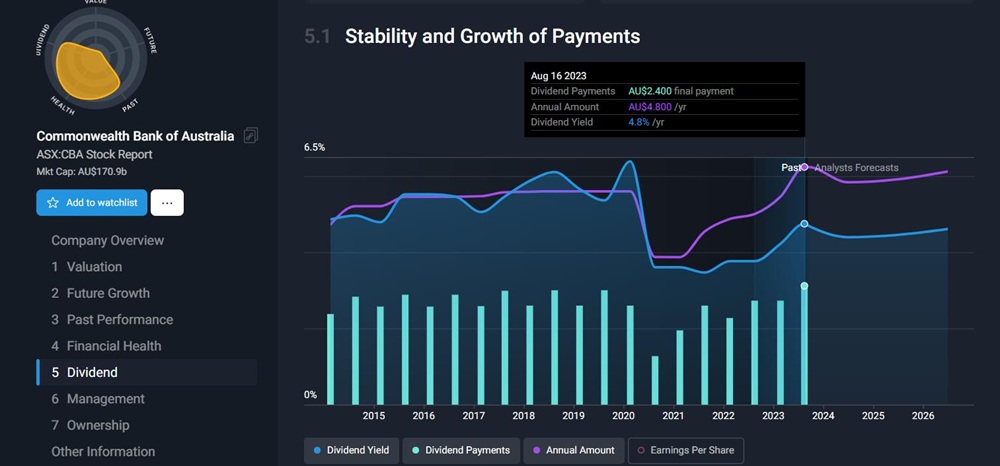
Commonwealth Bank of Australia is one of Australia's largest banking groups and has historically been an important contributor to dividend income for Australian investors.
Banks can benefit from large customer bases, lending activity and deposit franchises, although profitability is affected by interest rates, competition, credit losses and economic conditions.
Dividend Factors to Monitor
When researching CBA, investors can examine:
- Interim and final dividend payments
- Dividend payout ratio
- Net interest margin
- Bad-debt provisions
- Capital ratios
- Loan growth
- Deposit growth
2025 Considerations
The Australian banking environment remained closely linked to interest rates, household finances and competition for deposits and mortgages.
For dividend investors, the key question is not simply the current yield but whether earnings and capital generation can support distributions over time.
2. BHP Group Limited (ASX: BHP)
Mining Dividends Depend on Commodity Prices
BHP is one of the world's major diversified mining companies, with exposure to commodities including iron ore, copper and metallurgical coal.
Mining companies can produce substantial shareholder distributions during periods of strong commodity prices. At the same time, dividends can fluctuate considerably because commodity prices and earnings are cyclical.
Dividend Factors to Monitor
Investors researching BHP should consider:
- Iron ore prices
- Copper prices
- Production volumes
- Unit costs
- Capital expenditure
- Free cash flow
- Net debt
- Dividend payout policy
2025 Considerations
Copper remained an important long-term consideration because of its use in electricity networks, renewable energy and other infrastructure.
Investors researching Australia's resources sector can also explore our guide to Lithium Stocks Australia – Forecast 2026 and Beyond, which looks at lithium demand, supply cycles and risks.
At the same time, BHP's earnings remained exposed to commodity-price movements, making it different from more defensive dividend businesses.
3. Wesfarmers Limited (ASX: WES)
Diversified Retail and Industrial Exposure
Wesfarmers has exposure to major businesses including Bunnings, Kmart, Officeworks and other operations.
Its diversified portfolio provides exposure to several areas of the Australian economy rather than a single commodity or financial product.
Dividend Factors to Monitor
Investors can research:
- Retail sales growth
- Bunnings performance
- Kmart earnings
- Consumer spending
- Operating margins
- Capital expenditure
- Dividend growth
2025 Considerations
Consumer spending, wage growth, inflation and household budgets remained important factors for Wesfarmers.
Its diversification can help spread exposure across businesses, but individual divisions can still experience changes in demand and profitability.
4. Telstra Group Ltd (ASX: TLS)
Telecommunications Business with Recurring Revenue
Telstra operates one of Australia's largest telecommunications businesses and has significant exposure to mobile, broadband and enterprise customers.
Telecommunications businesses can provide recurring revenue streams, making them relevant to investors researching income-generating companies.
Dividend Factors to Monitor
Investors should consider:
- Mobile subscriber growth
- Average revenue per customer
- NBN performance
- Operating expenses
- Free cash flow
- Network investment
- Dividend policy
2025 Considerations
The continued development of 5G networks, mobile services, enterprise connectivity and digital infrastructure remained important themes.
However, telecommunications companies also need to invest heavily in networks and technology, meaning free cash flow is an important measure when assessing dividend sustainability.
5. Transurban Group (ASX: TCL)
Infrastructure Exposure Through Toll Roads
Transurban operates major toll-road assets in Australia and North America.
Toll-road infrastructure can generate recurring revenue because customers pay for access to established transport networks.
Dividend and Distribution Factors
Investors researching Transurban should examine:
- Traffic volumes
- Toll increases
- Inflation-linked pricing
- Operating costs
- Debt levels
- Interest expenses
- New infrastructure projects
- Distribution growth
2025 Considerations
Inflation-linked toll increases and traffic growth can support revenue, while higher interest rates can increase financing costs.
This makes Transurban an example of why investors should examine both the revenue model and the company's financing structure before assessing its income characteristics.
6. APA Group (ASX: APA)
Energy Infrastructure and Long-Term Revenue
APA Group owns and operates energy infrastructure assets across Australia, including gas transmission and electricity-related infrastructure.
Infrastructure businesses can generate relatively predictable revenue when supported by long-term contracts and regulated or contracted assets.
Dividend Factors to Monitor
Investors should examine:
- Operating cash flow
- Distribution coverage
- Debt levels
- Interest costs
- Contract duration
- Capital expenditure
- Regulatory developments
2025 Considerations
Australia's changing energy system created both opportunities and challenges for infrastructure operators.
Investors can also examine APA's exposure to renewable energy, electricity infrastructure and the broader transition in Australia's energy market.
7. Coles Group Limited (ASX: COL)
Supermarket Business with Defensive Demand
Coles operates one of Australia's largest supermarket networks.
Food and grocery spending tends to be more consistent than many discretionary purchases, which can make supermarkets relevant to investors researching defensive sectors.
Dividend Factors to Monitor
Important measures include:
- Comparable sales growth
- Food inflation
- Customer volumes
- Operating margins
- Online sales
- Cost efficiency
- Free cash flow
- Dividend growth
2025 Considerations
Competition in Australian grocery retail remained an important factor.
Automation, online grocery shopping, supply-chain efficiency and changes in consumer spending can influence future earnings.

How to Research ASX Dividend Stocks
Rather than selecting shares solely because they offer a high yield, investors can use a broader framework.
Compare Dividend Yield with Earnings
A high yield is not necessarily sustainable if earnings are declining.
Compare the current yield with:
- Historical yield
- Earnings growth
- Free cash flow
- Payout ratio
- Balance-sheet strength
Examine Dividend History
Review several years of dividend payments instead of focusing on a single recent distribution.
Investors should use current company announcements and ASX information when checking dividend amounts and payment dates.
Consider Sector Diversification
Investors may spread exposure across sectors rather than concentrating entirely on one dividend payer.
For example, banking, mining, telecommunications, infrastructure and consumer businesses can respond differently to economic conditions.
Our guide on How to Build an ASX 200-Focused Portfolio also discusses sector concentration and diversification within Australian equities.
Understand Franking Credits
Australian companies may attach franking credits to eligible dividends when Australian corporate tax has already been paid on the underlying profits.
The Australian Taxation Office explains that franking credits represent tax paid by a company and may provide a tax credit to eligible shareholders, subject to applicable rules.
Dividend Reinvestment Strategies
Reinvesting Dividends
Some companies offer Dividend Reinvestment Plans (DRPs), allowing eligible shareholders to use dividends to acquire additional shares rather than receiving the full amount as cash.
Over long periods, reinvestment can increase the number of shares held and potentially increase future dividend income.
However, investors should check the company's current DRP terms, including discounts, participation rules and pricing mechanisms.
Building a Diversified Income Portfolio
Investors may choose to spread exposure across sectors rather than concentrating entirely on one dividend payer.
A diversified approach can potentially reduce the effect of a dividend cut at any one company, although diversification cannot eliminate investment losses.
Risks of Investing in ASX Dividend Stocks
Dividend investing has several risks that should not be overlooked.
Dividend Cuts
Companies can reduce or cancel dividends if earnings weaken or capital requirements increase.
Share-Price Volatility
A dividend does not protect an investor from a falling share price.
A company paying a 5% dividend can still generate a negative total return if its share price falls significantly.
Interest-Rate Risk
Higher interest rates can affect businesses differently.
Companies with substantial debt may face higher financing costs, while income investors may compare dividend yields with alternative interest-bearing investments.
Commodity-Price Risk
Mining companies are particularly exposed to commodity cycles.
A fall in iron ore, copper or other commodity prices can reduce earnings and potentially affect dividends.
Dividend Traps
An unusually high yield can sometimes result from a falling share price rather than an improving dividend.
Investors should investigate why a yield is high before treating it as an income opportunity.
What to Check Before Buying an ASX Dividend Stock
A simple dividend-stock checklist can include:
- Current dividend yield
- Five-year dividend history
- Payout ratio
- Free cash flow
- Earnings growth
- Net debt
- Interest coverage
- Dividend policy
- Franking percentage
- Industry outlook
- Valuation
- Potential dividend-cut risks
This approach can provide a more complete picture than looking at yield alone.
Frequently Asked Questions About ASX Dividend Stocks
What are dividend stocks?
Dividend stocks are shares in companies that distribute part of their profits or available cash to shareholders through dividends.
Are ASX dividends guaranteed?
No. Companies decide whether to declare dividends based on their financial position, earnings, capital requirements and board decisions. Dividends can be reduced or cancelled.
Is a high dividend yield always better?
No. A high yield can result from a falling share price or a dividend that may not be sustainable. Investors should examine earnings, cash flow, payout ratios and balance-sheet strength.
What are franking credits?
Franking credits represent tax paid by an Australian company on profits associated with a franked dividend. Eligible shareholders may receive a corresponding tax credit, subject to Australian tax rules and their individual circumstances.
Can dividend reinvestment increase returns?
Reinvesting dividends can increase the number of shares held and create a compounding effect over time. However, future returns depend on share prices, dividend payments and company performance.
How often do ASX companies pay dividends?
Payment schedules vary. Many Australian companies pay dividends twice a year, although some companies pay quarterly, annually or according to other schedules.
Where can investors check ASX dividend information?
Investors can use ASX company announcements and dividend information to check historical and upcoming distributions. Dividend dates and amounts can change, so information should be verified against current announcements.
Conclusion: Researching ASX Dividend Stocks in 2025
Dividend-paying ASX companies can provide an important source of income while also offering potential exposure to long-term capital growth.
Companies such as Commonwealth Bank, BHP, Wesfarmers, Telstra, Transurban, APA Group and Coles operate across different sectors and have different earnings drivers. Their dividend characteristics, risks and growth prospects can therefore vary considerably.
For investors researching dividend stocks, the key is to look beyond the headline yield. Dividend history, earnings quality, free cash flow, payout ratios, balance-sheet strength, industry conditions and valuation can all influence the sustainability of future distributions.
Investors researching individual resource sectors can also explore StockBinge's ASX Gold Stocks coverage and Lithium Stocks Australia guide for additional sector-specific research.
Dividend investing should therefore be approached as a long-term research process rather than simply a search for the highest available yield.
Disclaimer: This article is for general information and educational purposes only and does not constitute personal financial advice. Dividend payments are not guaranteed, and share prices can rise or fall. Investors should conduct their own research and consider their financial circumstances and objectives before making investment decisions.
Talk to Our Experts
ABN 54 672 177 347 | ACN 672 177 347
Copyright © 2026 StockBinge. All Right Reserved. Design by StockBinge.