 info@stockbinge.com.au
 03 8609 4895

Blog Details
- Home
- Blog Details
How to Build an ASX 200-Focused Portfolio
For most Australians starting to invest, the S&P/ASX 200 is the natural starting point. It's the benchmark index for the local sharemarket — the 200 largest companies listed on the ASX by float-adjusted market capitalisation, spanning banks, miners, healthcare companies, retailers and more. Building a portfolio around it doesn't mean buying all 200 stocks; it means using the index as a map to build something diversified, sensible and aligned with your own goals.
This guide walks through the practical steps of building an ASX 200-focused portfolio from scratch, without assuming you already know the difference between a sector and a stock code.
Step 1: Understand What the ASX 200 Actually Is
The ASX 200 (ticker: XJO) isn't a company you can buy — it's an index, a basket of the 200 biggest ASX-listed companies weighted by size. When people talk about "the market being up or down today," they're usually talking about this index.
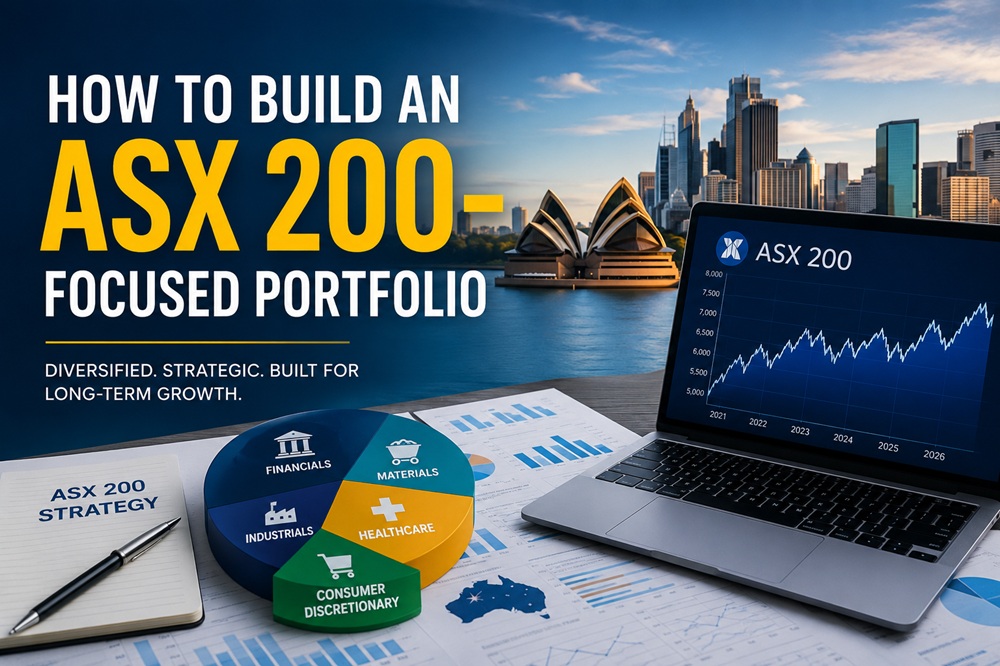
What makes the ASX 200 distinctive compared to indices like the US S&P 500 is its sector mix. Two sectors dominate: financials (mainly the big banks) and materials (mining and resources companies) together make up more than half the index by weight. Healthcare, industrials, consumer discretionary and real estate make up meaningful but smaller slices, and sectors like information technology remain a comparatively small part of the index — a very different shape to more tech-heavy overseas markets.
Why does this matter for a beginner? Because if you're not paying attention, an ASX-focused portfolio can end up far more concentrated in banks and miners than you realise, even if you think you're diversified.

Before choosing individual companies, investors can also learn more about ASX stock research and the process of evaluating listed businesses.
Step 2: Decide How You Want Exposure — ETF, Direct Shares, or Both
There are two broad paths to building an ASX 200-focused portfolio, and most people end up using a mix of both.
Index ETFs. An ASX 200 index fund or ETF buys you a slice of all 200 companies in one trade, weighted the same way as the index. This is the simplest, lowest-effort way to get broad exposure, and it's a reasonable core holding for someone just starting out — instant diversification, low fees, and no need to research individual companies.
Direct shares. Buying individual ASX 200 companies lets you tilt your portfolio toward sectors or businesses you believe in, potentially target dividend income, and avoid parts of the index you're less comfortable with. This requires more research and ongoing attention, but it gives you control that a broad index fund doesn't.
A common beginner approach is a core-and-satellite structure: use a low-cost ASX 200 ETF as the core of the portfolio for automatic diversification, then add a smaller number of individual stocks around it — companies you've researched and have a specific reason to hold — as the satellite portion.

Step 3: Think About Diversification Beyond "I Own the ASX 200"
Owning an ASX 200 ETF feels diversified because it holds 200 companies, but true diversification is about more than the number of stocks — it's about how correlated they are.
Given how index-heavy financials and materials are, an investor who builds a portfolio entirely from ASX 200 large caps is still making a significant bet on Australian bank earnings and global commodity cycles. It's worth asking:
- Am I comfortable with how much of my portfolio depends on the health of Australian banks?
- Do I want exposure to global growth sectors — technology, healthcare innovation, international consumer brands — that are underrepresented on the ASX?
- Investors researching technology and infrastructure themes can also explore ASX data centre stocks, particularly as AI and cloud computing drive demand for digital infrastructure.
- Should some portion of my portfolio sit in international shares or a global ETF, rather than staying 100% domestic?
Many long-term Australian investors pair an ASX 200 core with some international equity exposure specifically to offset this concentration, rather than trying to solve it entirely with local stock-picking.
Another way investors may research specific Australian growth themes is through lithium stocks in Australia, given the country's significant resources exposure.

Step 4: Match Your Portfolio to Your Goals and Timeframe
Before selecting stocks or ETFs, it helps to be honest about what you're actually building the portfolio for.
If you're investing for growth over a long timeframe (10+ years): you likely have more room to accept short-term volatility, which might mean tilting slightly toward sectors like healthcare, technology or emerging industrials within the ASX 200, alongside your core holdings.
If you want income now: the ASX 200 is well known for dividend-paying blue chips, particularly among the major banks and diversified miners, many of which pay dividends with franking credits — a distinctly Australian tax feature worth understanding before you build an income-focused portfolio.
If you're investing for a shorter-term goal: a heavily concentrated, high-volatility approach is generally harder to justify, and a broader, more conservative core position may suit better.
There's no single right answer here — the point is to define the goal first, then build the portfolio around it, rather than picking stocks first and hoping they add up to something coherent.
Step 5: Build In a Process, Not Just a Starting Portfolio
A portfolio isn't something you build once and leave alone. A simple, repeatable process matters more than picking the "perfect" starting stocks.
- Set a rough target allocation across sectors or asset classes, even a simple one, so you can see when your portfolio has drifted from it.
- Review periodically, not constantly. Checking in quarterly or twice a year is generally more useful than reacting to daily price moves.
- Rebalance when needed — if one sector or stock has grown to dominate your portfolio through price appreciation alone, consider whether that's a decision you're actually comfortable with, or simply what happened by default.
- Keep researching. Company fundamentals, sector conditions and the broader economic backdrop all shift over time, and a portfolio built on last year's research can quietly become outdated.
The Bottom Line
Building an ASX 200-focused portfolio doesn't require picking 200 stocks or timing the market perfectly. It starts with understanding what the index actually holds, choosing a sensible mix of ETF and direct-share exposure, being honest about concentration risk in banks and resources, and matching your holdings to your own timeframe and goals. From there, it's about consistency — a clear process for reviewing and rebalancing matters far more over the long run than any single stock pick.
This article is for general informational purposes only and does not constitute personal financial advice. Consider your own circumstances, or speak with a licensed financial adviser, before making investment decisions.
Talk to Our Experts
ABN 54 672 177 347 | ACN 672 177 347
Copyright © 2026 StockBinge. All Right Reserved. Design by StockBinge.