
BHP Stock Price Forecast 2027: Share Price Prediction, Buy Case and ASX Investment Analysis
BHP Stock Forecast for 2027
BHP Group (ASX: BHP) enters 2027 with a stronger copper growth story, record FY2026 iron-ore production and a new potash business approaching first production.
The main challenge is valuation. Public analyst estimates are wide, and commodity prices can change faster than earnings forecasts. A single point target for 2027 would create false precision.
The more useful question is whether copper growth, Jansen delivery and iron-ore cash generation can outweigh the risks from China, commodity prices and project execution.
BHP Share Price and Analyst Forecast Range
TradingView’s published third-party 12-month analyst range shows a low estimate of A$43.42 and a high estimate of A$70.67. Its current reference price was A$60.94 when accessed on 12 October 2026.
That range represents approximately 28.7% downside to the low and 16.0% upside to the high. It is not a 2027 target, but it shows how widely market expectations differ.
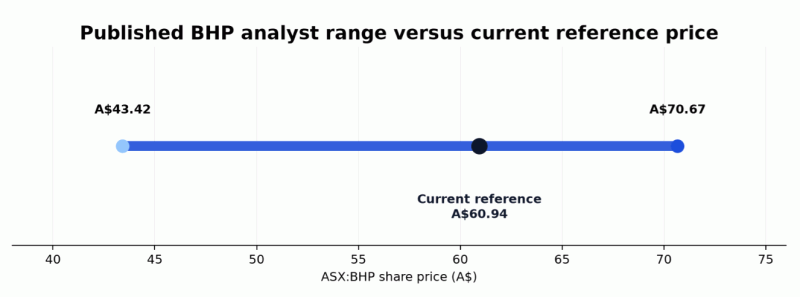
Source: TradingView, accessed 12 October 2026. The range is a third-party 12-month estimate, not a guaranteed 2027 forecast.
What is driving the BHP share price?
BHP is a diversified mining group focused on copper, iron ore, steelmaking coal and potash, with earnings driven by commodity prices, production, costs and capital spending.
BHP entered FY2027 on a strong FY2026 performance, reporting US$33 billion in underlying EBITDA, US$9.8 billion in free cash flow and US$9.8 billion in attributable profit. Free cash flow rose 83%, while EBITDA increased 27%. Net debt fell below US$9 billion.
BHP declared total FY2026 dividends of US$1.72 per share, although future payouts will depend on earnings and capital needs.
Copper is its key growth driver, contributing about US$18 billion in EBITDA—over half of group EBITDA. BHP plans to invest around US$11 billion annually in medium-term capital projects, with over half allocated to copper, and expects average annual copper-equivalent production growth of about 5% from FY2027 to FY2035.
BHP 2027 Price Prediction: What Can Be Said?
There is no dependable, widely published consensus price target specifically for December 2027. BHP’s own consensus page also warns that analyst estimates can change significantly as commodity prices move.
- A sensible 2027 framework is therefore scenario-based:
- Bull case: copper prices remain strong, production grows, Jansen starts on schedule and iron ore stays cash-generative.
- Base case: copper growth offsets softer iron ore conditions, while Jansen contributes strategically but only modestly to near-term earnings.
- Bear case: copper and iron ore prices weaken together, China disappoints and project costs or delays reduce free cash flow.
For BHP, the commodity cycle may matter more than a simple earnings-growth extrapolation.
BHP FY2026 Results: The Starting Point for 2027
BHP reported approximately US$33 billion of underlying EBITDA for FY2026 and reduced net debt to below US$9 billion.
The company also paid a final dividend of US$0.99 per share, its largest final dividend in four years.
Copper was the most important change in the earnings mix. BHP said copper contributed more than half of underlying EBITDA for the first time.
That shift makes BHP more exposed to copper’s upside, but also more sensitive to copper-price volatility and operational performance at its copper assets.
FY2027 production matters more than the long-term story
BHP’s FY2027 operational guidance provides a useful reality check. The company expects total copper production of 1.65–1.80 million tonnes, compared with approximately 1.95 million tonnes in FY2026. Escondida, BHP’s largest copper operation, is guided at 1.00–1.10 million tonnes. The operational review attributes the expected decline mainly to a lower concentrator feed grade, with FY2027 grade expected to be about 0.70%.
That does not invalidate the copper thesis, but it changes the earnings path. A higher copper price can offset lower volumes, while a falling copper price can amplify the effect of a production decline. Investors should watch realised copper prices, unit costs, recoveries and progress on Escondida and Spence projects rather than relying only on long-term demand estimates.
Iron ore remains the stabilising cash-flow engine, but it is also the clearest 2027 valuation risk. BHP’s FY2027 iron ore guidance is 260–272 million tonnes, including 253–264 million tonnes from WAIO. The company describes WAIO as a very low-cost major iron ore business, which means it may remain profitable even if prices fall. Low cost is valuable, but it does not make earnings immune to price declines.
BHP also expects Jansen Stage 1 potash to reach first production in mid-calendar 2027. That project could add long-term diversification, although the initial contribution may be less important to FY2027 earnings than the market’s expectations around copper and iron ore.
Copper outlook: the main upside catalyst
BHP expects global copper demand to rise from about 34 million tonnes per year today to more than 50 million tonnes by 2050.
The company also estimates that more than 2.5 million tonnes of uncommitted mine supply may be needed by 2030 to keep the market balanced.
This is the central long-term argument for BHP. Copper is needed for grids, electrification, renewable power, electric vehicles and digital infrastructure.
BHP has a pipeline of projects that could lift attributable copper production by about 40% by FY2035.
Iron ore outlook: the main downside risk
Iron ore is more exposed to China’s property and industrial cycle than copper. BHP’s own outlook argues that Chinese steel production has remained close to one billion tonnes for several years and could stay around that level through the decade, while India and Southeast Asia provide longer-term steel demand. It also points to growing Indian iron ore imports and the strategic value of reliable low-cost supply.
The World Bank is more cautious on the price direction. It expects iron ore prices to fall in 2026 and 2027 as ample supply and weak demand weigh on the market. The RBA has also noted that Australian iron ore exports should normalise after a period of inventory rebuilding in China.
This is why BHP’s 2027 share price may not track copper one-for-one. A strong copper market can lift sentiment, but a steep iron ore decline would reduce group cash generation and could pressure dividends, buybacks or valuation multiples. The base case therefore assumes iron ore weakens moderately rather than returning to an extreme boom-period price.
BHP Dividend Outlook for 2027
BHP pays dividends semi-annually, but its payout is not fixed. It depends on commodity prices, earnings, capital spending, debt and investment opportunities.
The FY2026 final dividend was strong, but investors should not extrapolate it automatically into 2027. A higher copper investment program or weaker iron-ore pricing could reduce cash available for distributions.
For income investors, BHP is best viewed as a variable-income resource company rather than a bond substitute.
Australian market and macroeconomic backdrop
Australian investors also need to consider the local market environment. The IMF projects Australian real GDP growth of 1.9% in 2026 and 1.6% in 2027, with inflation expected to return gradually toward the RBA’s 2–3% target band. It says financial conditions have tightened and notes that further monetary tightening could be required if inflation risks persist.
The RBA’s May 2026 forecasts similarly show subdued growth through 2027, with the cash-rate assumption at 4.7% in December 2027. Higher rates can weigh on equity valuations and domestic demand, although BHP earns much of its revenue from globally priced commodities rather than Australian consumers.
The Australian dollar is another important variable. BHP reports most commodities in US dollars but incurs costs across several currencies, including the Australian dollar and Chilean peso. A weaker Australian dollar can support translated earnings and margins, while a stronger currency can reduce that benefit. Currency movements should therefore be included in any serious ASX BHP investment analysis.
Is BHP a Buy for 2027?
BHP has a credible long-term investment case, but it is not risk-free or automatically cheap.
The bullish case rests on copper growth, strong balance-sheet management and successful Jansen delivery. The cautious case is that a large part of the copper narrative is already reflected in the share price, while commodity prices remain cyclical.
BHP may suit investors who want diversified mining exposure and can tolerate variable dividends and commodity-driven volatility. It may be less suitable for investors seeking predictable earnings or a fixed income stream.
A disciplined investor could compare the current price with conservative, base and optimistic commodity assumptions rather than relying on one headline target.
BHP share price prediction for 2027: scenario framework
In the bear case of A$52–A$62, iron ore falls materially, copper gives back part of its recent strength, FY2027 copper volumes disappoint, and higher rates or risk aversion compress the mining-sector multiple. This range would imply that the market prioritises near-term earnings risk over BHP’s long-term growth pipeline.
In the base case of A$68–A$80, copper remains supported, iron ore declines moderately, BHP stays within its production and cost guidance, and the company continues to generate enough cash for disciplined investment and shareholder returns. This is the most balanced interpretation of the available evidence and would represent moderate appreciation from the approximately A$60.94 reference price.
In the bull case of A$88–A$105, copper prices remain elevated or move higher, supply disruptions reinforce the copper deficit, BHP executes its growth projects, and iron ore remains more resilient than the World Bank baseline. A stronger bull market for mining shares or a weaker Australian dollar could add to the upside.
These ranges are intentionally wide. A precise 2027 target would create false confidence because BHP’s earnings depend on several volatile inputs. The most useful forecast is one that identifies what would make the thesis work and what would invalidate it.
What to monitor before relying on the forecast
Investors should monitor BHP’s quarterly production reports, Escondida grades and recoveries, copper realised prices, WAIO shipments, unit costs, net debt, capital expenditure and the timing of Jansen. Commodity prices matter, but operational delivery can be just as important.
The investment thesis would weaken if copper prices fell while production remained below guidance, if iron ore prices declined faster than expected, if major projects experienced cost overruns or if management increased leverage to protect distributions. Conversely, the thesis would strengthen if copper volumes recover, costs remain controlled, debt stays low and the growth portfolio advances without undermining shareholder returns.
Final view
The BHP stock price forecast for 2027 is cautiously constructive but highly conditional. BHP combines strong assets and balance-sheet capacity with meaningful exposure to two different commodity cycles. Copper gives the company a credible long-term growth engine, while iron ore still provides much of the near-term cash-flow foundation.
For an ASX BHP investment analysis, the key conclusion is not that BHP must rise. It is that the stock offers a potentially attractive risk-reward profile when bought at a valuation that already allows for weaker iron ore and temporary copper-volume pressure. The base-case range of A$68–A$80 is plausible if execution remains solid, but the bear case remains realistic. Investors should use the ranges as a framework for research, not as a promise of future returns.
Updated 9 October 2026. Market prices move continuously. This article is general information, not personal financial advice or a recommendation to buy or sell BHP shares.
BHP Stock Forecast FAQs
What is the BHP share price forecast for 2027?
There is no reliable single consensus target specifically for 2027. Public third-party 12-month estimates accessed in October 2026 ranged from A$43.42 to A$70.67. Investors should treat this as a broad expectation range, not a prediction.
What is the main reason to buy BHP shares?
The strongest argument is BHP’s growing copper exposure combined with large, established iron-ore operations and a new potash growth platform.
Is BHP mainly a copper stock now?
Copper has become its most important growth driver, contributing more than half of FY2026 underlying EBITDA. However, BHP remains diversified across iron ore, metallurgical coal and potash.
When will Jansen produce potash?
BHP says Jansen Stage 1 is on track for first production in mid-CY27. The timing and ramp-up should be monitored because project schedules can change.
Is BHP a good dividend stock?
BHP has a record of paying substantial dividends, but the amount varies with commodity prices, earnings, capital spending and balance-sheet needs. It should not be treated as a fixed-income investment.
What could push BHP shares higher in 2027?
Potential catalysts include stronger copper prices, reliable production, Jansen starting on schedule, supportive iron-ore pricing and successful project decisions.
What could push BHP shares lower?
Potential negatives include weaker copper or iron-ore prices, weaker Chinese demand, cost inflation, project delays, operating disruptions and a lower valuation multiple.
Is this article financial advice?
No. It is general educational information. Investors should review the latest ASX announcements, financial statements and valuation evidence and consider their own circumstances before making a decision.
References
[2] BHP Results for the full year ended 30 June 2026